

📌 Key Takeaways
Persian desserts are known for their fragrant use of saffron, rosewater, cardamom, pistachios, walnuts, and dates rather than relying solely on sweetness. This article takes readers through 10 distinctive Iranian sweets, including Gaz, Sohan, Kolompeh, Haji Badam, Loz, Kaak, and Reshteh Khoshkar, while explaining their regional origins and cultural significance. It also shares practical tips for finding authentic Persian sweets and choosing them as gifts. For those wanting to experience these flavors locally, a persian restaurant houston can be a natural place to explore Persian sweets and traditional cuisine.
I still remember the first time someone handed me a piece of Gaz. It was wrapped in a thin paper sleeve, bought from a small shop in Isfahan, and the woman who gave it to me looked almost nervous, like she was waiting to see if I would understand it. I did not expect much. It looked like any other nougat. Then I bit into it and got that wave of rosewater and pistachio, and I thought why does nobody talk about this?
That is the thing about Persian food houston. People outside Iran either have not tried them or have only had a mediocre version bought from the wrong place. The real ones the Sohan made fresh in Qom, the Kolompeh packed with dates in Kerman, the Loz cut into diamonds in a Tabriz sweet shop, are in a completely different league.
This is not a neutral list. These are the Persian desserts I think are genuinely worth going out of your way for, with honest notes on what makes each one special and how Aban Persian Restaurant can help you experience authentic Persian flavors if you are not traveling to Iran anytime soon.
What Makes Persian Desserts So Different?
Honestly, it comes down to fragrance over sweetness.
Most Western sweets are built on butter and sugar. Persian sweets are built on saffron, rosewater, cardamom, and nuts. The sugar is there, do not get me wrong, but it plays second fiddle. You eat a piece of Sohan, and your first thought is not "sweet." Your first thought is "saffron." That is a completely different experience from a Kit Kat or a croissant.
The other thing worth knowing is that Iranian desserts are almost all hyperlocal. Each city, sometimes each village, has its own sweet that it considers a matter of civic pride. Gaz belongs to Isfahan the way Sohan belongs to Qom. Bring someone from Qom a box of inferior Sohan bought at a highway rest stop and watch their face. They will know immediately. That kind of local pride produces exceptional food.
And then there is the cultural layer. These Persian sweets are not casual snacks. They come out with tea when guests arrive. They sit on the Nowruz table as symbols. They get packed into suitcases as gifts for relatives abroad. Food that carries that kind of meaning tends to be made with more care than food that does not.
The 10 Best Persian Desserts Worth Knowing
1. Gaz : Persian Nougat from Isfahan
Start here. If you have never had a Persian dessert before in your life, start with Gaz.
It is white, slightly chewy, and studded with pistachios. It smells like a rose garden that someone left a pot of honey in. The texture is somewhere between marshmallow and marzipan, bouncy but not sticky, firm but not hard. A good piece of Gaz melts slowly rather than all at once.
Isfahan has been making this since the Safavid period, which means centuries of refinement went into what you are eating. Qajar kings apparently used to gift it to foreign courts. That is not marketing, that is history.
The version you find in a proper Isfahan shop is made with golab (rosewater), glucose syrup, egg whites, and the best local pistachios. The version sold at random airport stalls is a distant cousin. Buy the real thing if you ever get the chance.
2. Sohan : Saffron Brittle from Qom
Sohan is the Persian sweet that Iranians themselves are most fanatical about. Ask someone from Qom about their Sohan, and they will spend ten minutes explaining why every other version is inferior.
They are not wrong. Qom Sohan is an extraordinary flat, amber slab of caramelized saffron with pistachios pressed into the top. It shatters when you snap it. Then it melts on your tongue in this slow, warm wave that is almost entirely saffron and rosewater with sugar as an afterthought. It is one of those Persian desserts where the quality of the saffron matters enormously. Bad saffron produces forgettable Sohan. Good saffron produces something you think about for days.
Small piece, strong tea, no hurry. That is the correct way to eat Sohan.
3. Kolompeh : Persian Date Pastry from Kerman
Kerman does not get the tourist attention it deserves, and neither does Kolompeh. This round Persian pastry looks modest from the outside, golden, slightly domed, about the size of your palm. Inside is where things get serious: a dark, dense filling of dates, walnuts, saffron, and spices that tastes like someone distilled autumn into a paste.
The crust is crumbly and short, almost like a good pie pastry. The filling is sticky and rich. Together, they work in a way that feels inevitable, like this combination was always going to be right.
It travels well, which is why it became one of Iran's most gifted sweets. People from Kerman bring it back for family, the way people from Naples bring sfogliatelle. If you spot Kolompeh labeled as "Persian Date Pastry" in an international shop, that is this buy it.
4. Badam Sookhteh : Caramelized Almonds from Shiraz
The name means "burnt almonds." They are not burnt. They are almonds that have been dropped into a copper pot of violently hot caramelized sugar, stirred until each one is coated in a thin crackling shell, and then left to cool on a marble slab.
What you get is this crunchy, slightly bitter-edged, deeply satisfying Persian sweet that disappears faster than you intend. The heat does toast the almond inside, which is the "burnt," and that toastiness against the caramel is exactly the point.
In Shiraz, this sits on the Haft-Sin table at Nowruz. Kids go for it first. Grown adults pretend they are not doing the same thing. It is the kind of Persian dessert that requires zero explanation; you just eat it and immediately understand.
5. Haji Badam : Almond Cookies from Yazd
Yazd has a serious reputation for Persian pastry, and Haji Badam is the proof. These are small, soft almond cookies flavored with saffron and a little nutmeg. They are nothing like the almond cookies you find elsewhere. They are quieter. More aromatic. Less sweet than you expect. The texture is closer to firm marzipan than to a baked biscuit.
The name means something like "the almond of the elder uncle," the story being that a distant male relative always seemed to show up at gatherings carrying these. Whether or not that is true, the image fits. Haji Badam feels like a sweet that belongs to memory more than to menus.
Among Persian desserts that use almond as the hero ingredient, this is the best one I have come across. Worth hunting down at a proper Persian bakery.
6. Loz : Diamond-Shaped Candy from Tabriz
Tabriz is Iran's northwest, shaped by Azerbaijani culture and centuries of trade, and its sweets reflect that Loz does not taste like anything else from Iran.
The base is a saffron and cardamom caramel syrup, cooked to a specific temperature and then folded with a paste of walnuts, pistachios, or coconut. Sometimes two pastes are layered together. The mixture is poured flat, left to set, and then cut into those precise diamond shapes that make Loz so visually distinctive.
The texture is somewhere between fudge and brittle. The saffron is prominent more so than in most Iranian desserts. If you find most Persian sweets a touch too mild, Loz will feel like a step up in intensity without losing any of the elegance. It is one of those sweets where you can tell someone made considered decisions about every element.
7. Kaak : Layered Sweet from Kermanshah
Kermanshah is underrated as a food destination, and Kaak is the single best argument for changing that.
It is multilayered, rectangular, and almost absurdly light. Each layer is separated by powdered sugar and spices, cinnamon, cardamom, hints of coconut, and the whole structure is so airy that eating it feels like it should not be as satisfying as it is. But it is. Decorated with crushed pistachios or almonds on top, it looks like something that took considerable skill to make, because it did.
Kaak is the Persian sweet that people always regret not buying more of. Every traveler who has brought it back from Kermanshah has said the same thing: should have bought three boxes instead of one. Take that as your cue.
8. Komaj : Sweet Spiced Bread from Hamadan
Komaj sits outside most people's image of what a Persian dessert should be. It is not candy. It is not brittle. It is a round, baked good from Hamadan made with cardamom, vanilla, and sherbet folded into the dough, topped with sesame seeds, sometimes stuffed with walnuts and sugar inside.
It is closer to a morning pastry than a dessert, and in Hamadan it gets eaten that way with tea, at any hour, without ceremony. Among all the Iranian desserts on this list, Komaj is the most everyday. The least occasion-dependent. The kind of thing someone keeps in the kitchen and cuts a piece from whenever the mood strikes.
If you tend to find Persian sweets too sugary or too rich, Komaj is your entry point.
9. Leghimat : Fried Dough from Bushehr
Go south, and the desert culture changes entirely. Bushehr sits on the Persian Gulf, where Persian and Arab culinary traditions have been overlapping for centuries, and Leghimat is what that overlap looks like at its best.
Small balls of rice flour dough, fried until golden, soaked in date syrup. They are crispy on the outside, soft and almost custardy inside, sticky all over. The date syrup gives them a molasses depth that keeps them from tasting like ordinary fried dough.
Leghimat is Ramadan food in Bushehr, made after iftar, eaten warm, shared around a table. That context matters. It is the kind of food that tastes better when it is 30 degrees outside, and you have been fasting all day. But honestly, it is good any time. If you have ever eaten loukoumades or gulab jamun, you will love Leghimat immediately.
Among all the Persian sweets on this list, this one gets the least attention internationally. Which means when you find it, you feel like you found something.
10. Reshteh Khoshkar : Walnut Sweet from Gilan
Gilan is the green, humid, Caspian-facing north of Iran, a completely different world from the central desert cities. And Reshteh Khoshkar is a completely different kind of Persian pastry.
A paper-thin sheet of batter gets stretched until you can nearly see through it. Then it is filled with walnuts, sugar, and nutmeg, folded shut, and fried until it turns a deep amber. Crispy outside, soft and fragrant inside. The walnut filling is not sweet, it is earthy and slightly bitter against the crunch of the shell.
The technique to stretch the batter thin enough without tearing it takes years to learn. There is no shortcut. There is no good version of this Persian dessert made by someone who learned it last month. You either go to Rasht and eat it there, or you miss it. That is a good reason to go to Rasht.
A Few More Worth Mentioning
Ten is not enough. Some others that deserve your attention:
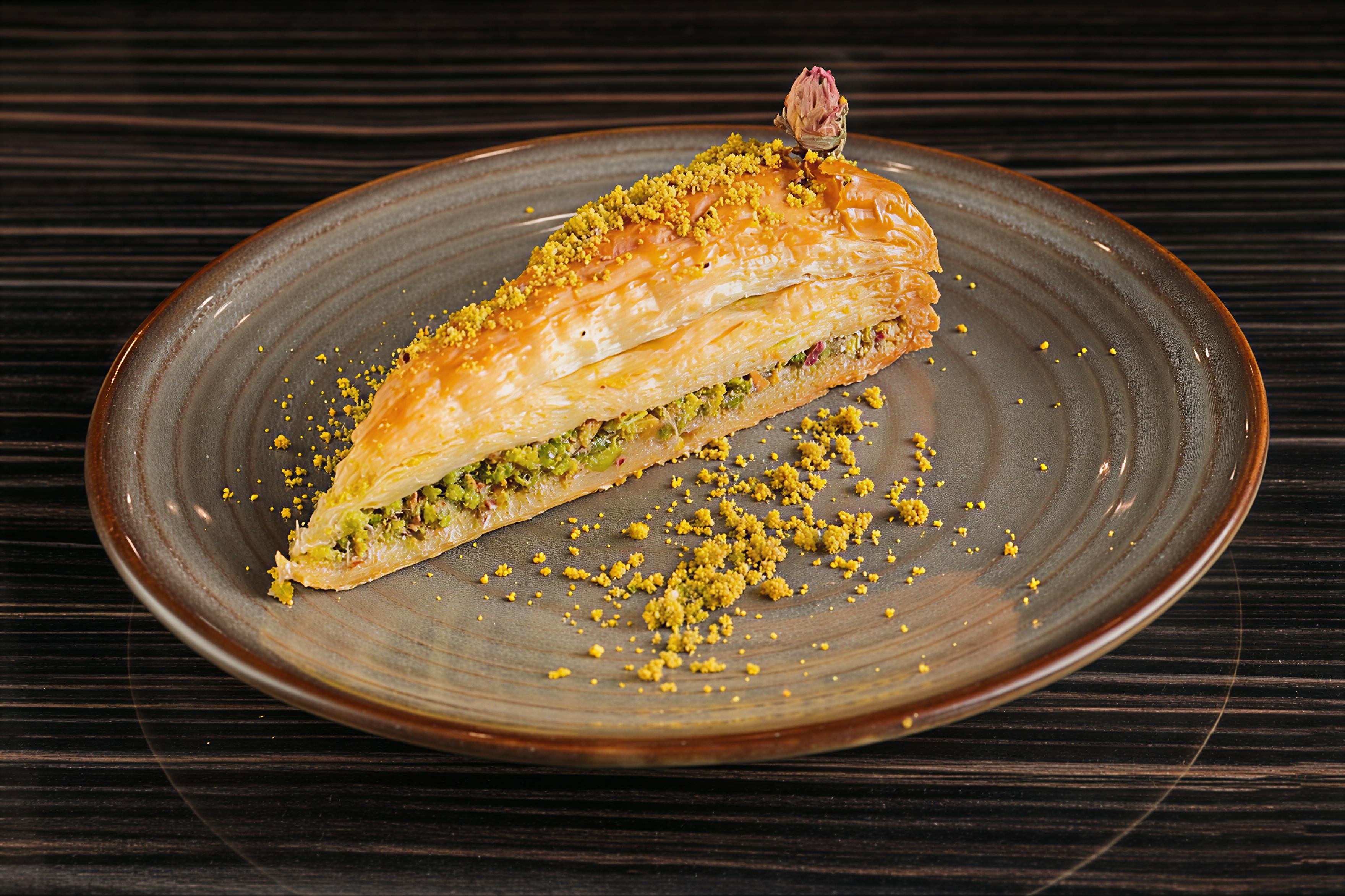
Yazd Baklava : lighter than anything you have tried under that name, with rosewater where you expect heavy syrup.
Poolaki of Isfahan : paper-thin saffron or mint sugar wafers that dissolve before you register them.
Ranginak of Khorasan : dates stuffed with walnuts, pressed into toasted flour and cinnamon. Dense and deeply good.
Rosary Chocolates of Tabriz : proof that Iranian desserts are not only ancient recipes. Modern and worth trying.
How to Find Persian Sweets Near Me
Finding Persian sweets near me used to mean knowing exactly which neighborhood had an Iranian grocery or specialty shop. That is less true now, with places like Aban Persian Restaurant making authentic Persian flavors more accessible to diners looking to explore Persian cuisine.
Google Maps with the search terms "Persian bakery" or "Iranian grocery" will get you somewhere in most large cities. Toronto, Los Angeles, London, Dubai, and Melbourne all have established Iranian communities with proper shops, not just one or two items on a supermarket shelf, but actual Persian pastry counters.
Middle Eastern grocery stores are a reasonable second option. They often stock packaged Gaz and Sohan even if they do not specialize in Persian food.
Online is the third route. Several importers now ship sealed Gaz, Sohan, and Kolompeh internationally. The quality is genuinely decent for those three, because they hold up well in transit.
One thing worth saying: the gap between fresh Sohan from a Qom shop and packaged Sohan from an online retailer is real. Both are worth eating. They are not the same experience. If you ever get the chance to try these Persian desserts at a Persian restaurant houston, you'll experience a taste that's worth every try.
Buying Persian Sweets as Gifts : Practical Notes
Persian sweets have been given as gifts for generations, making them a cherished part of the culture and something you can easily find when looking for a Persian restaurant nearby. Gaz was a diplomatic currency for Qajar kings. Sohan is what you bring when you visit someone's home in Qom. Kolompeh is what Kerman locals pack into suitcases for relatives abroad.
If you want to give Persian desserts as gifts, here is what to know:
Gaz, Sohan, and Kolompeh travel well and last. These are your safest options.
Leghimat and Reshteh Khoshkar do not travel. Eat them where they are made.
Customs is rarely a problem for baked or dried Persian sweets, but worth checking if you are crossing international borders, especially with egg- or dairy-containing items.
Buy from the origin city when you can. A box of Gaz from Isfahan is not the same as a box of Gaz from a Tehran airport shop. Both will tell you "Isfahan Gaz" on the label. Only one is telling the full truth.
 Omojet